Buying an Aluminum Awning
Tips Before You Buy An Awning
Are you in the process of buying an aluminum awning, a patio cover or a carport awning? Aluminum awnings offer many advantages over other types of construction. Aluminum is virtually maintenance free and will stay looking new for years. There are some terms you should be familiar with before making an awning purchase.
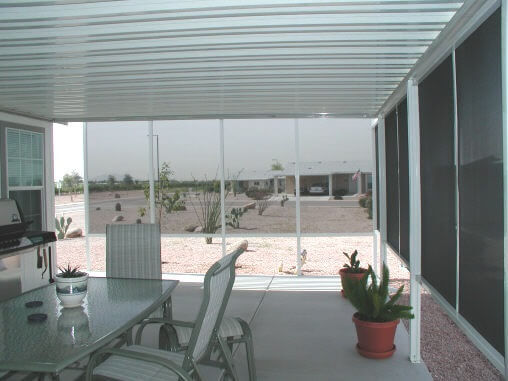
The many different components that make up an awning all contribute to the overall strength of the installed structure. If you are in an area that requires a permit a lot of these factors will be decided for you. It is still a good idea to know exactly what you are getting before you place your order.
Awning panel thickness is an important consideration when buying an aluminum awning. The thickness is referred to as gauge. The most common gauges are 20, 25, 32 and 40. A 40 gauge panel is the thickest and is used only when the highest wind factor or snow load ratings are required. Because of there thickness these panels can be difficult to work with and are not used very often.
A 20 gauge panel is used mostly on awnings with 8', 9' or 10' projections. Awnings that span 12' or greater should be using 25 or 32 gauge.
A term you will read about in your permit requirements is a tributary width. That would be the longest distance the panels have to span without support. An example would be a 20' awning with an I-beam set in the center. The beam would leave a 10' span on either side. You may have a 20' projection awning but your panel thickness requirement would be for that of a 10' awning.
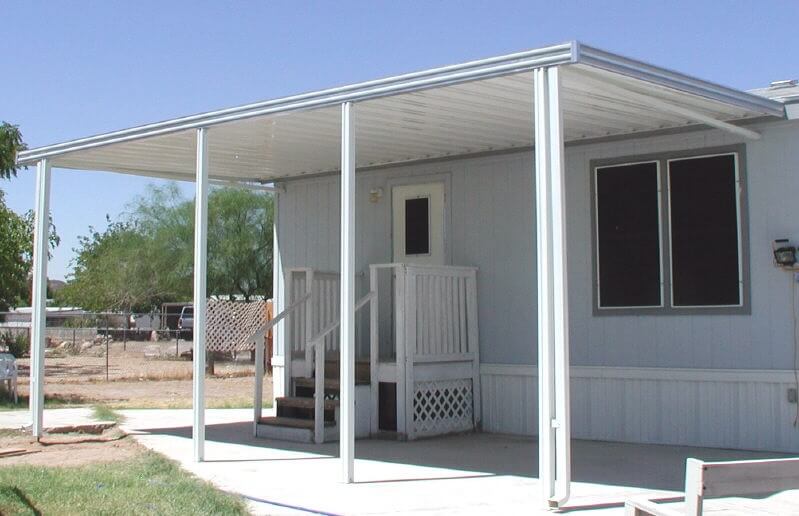
The awning posts are another option you will need to consider when buying an aluminum awning. Scroll posts are the least expensive and are usually offered in a starter package. You may want to pass on these. They are made with roll form tubes held together with scrolls. They were fine for many years, your grandma may still have them on her awning. They are just way out of fashion. Why not spend a few extra dollars and get the 3" square posts? They are much stronger and give an aluminum awning a modern look.
The 3" posts are available in aluminum or steel. Steel posts will probably save you a few dollars. The cost of aluminum is high and the steel posts are actually a little stronger. The posts are usually available in a white or a neutral color. Posts are also available in different lengths. They can be ordered as 8', 9', 10' or 12' posts. Take careful measurements before ordering. Make sure your posts will be long enough but don't pay for more than you need. Like the framework, make sure you see in writing exactly what posts you will be getting.
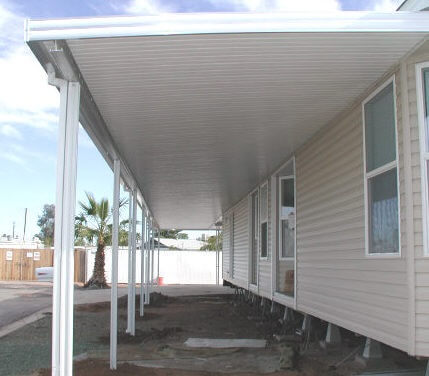
The color trim snaps into your extruded gutter and side fascias. You may have a few color choices or you may have dozens. These 2" strips are used to match the awning to your home. Your color selection can make a big difference. Will your awning look like it is part of your home or an afterthought? These color bands really do make a difference so choose carefully. And if you choose badly, they can always be changed. I can change out all the trim in an awning in less than an hour. That makes it nice if you decide to paint your house in a few years and want new trim to match.
Your city permit application will talk about live loads and snow loads. These are obtained by a combination of post type and thickness, gutter type and panel style and gauge. There are a few other factors, like distance allowed between posts, but this is all detailed in the manufactures engineering specifications.
It is very likely you will need to have the engineering mailed to you before you purchase the awning. The engineering will be needed to obtain a permit. Do not buy an awning until you have the permit, if you need one. A reputable company will gladly send the needed paperwork so that you can get you permit. When you order the awning make sure you are getting the same material highlighted in their engineering.
Do some research and use some common sense. Most aluminum awnings are custom made. A lot of work goes into putting together an awning package and getting it delivered to your home. A lot of work and a whole lot of expense. One mistake could take away any profit the dealer may have and could wind up costing you weeks of time to get it corrected. Do everything on your end, to make sure you know what you need, before you make your awning purchase.
Aluminum Awning Parts | Awnings and Snow | Additional Awning Parts | Patio Shade | How to Build Wood Awnings
Versa Tube Shelter | Awning Building Tools | Dangers of Shade | Aluminum Awnings | Used Aluminum Awnings
Screen Room and Aluma Lattice | Awning Plans | Do-It-Yourself Patio Covers | Metal Awnings | Awning Installation
Aluminum Awnings and Window Awnings | Missouri Awning | Awning Contractors
Patio Awning | Do-It-Yourself Help | Arizona Awning Quote

Awnings
Alumawood Patio Covers
Patio Covers
Awnings
Carport Cover
Mobile Home Awnings
Portable Awnings
Shade Projects
Do It Yourself
Window Shade
Deck Shade
Pet Shade
Shade Screens
Pools
Site Info
Contractors
Contact
Site Map
Shade Shop


